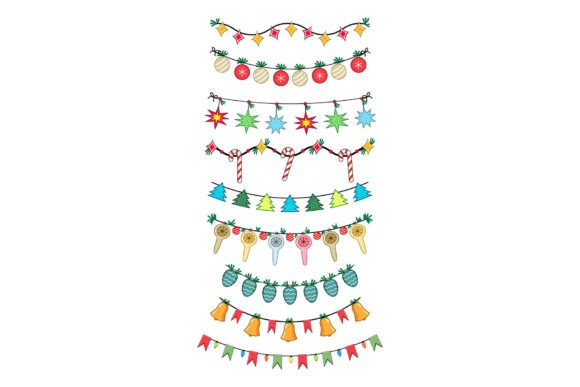
Colorful Christmas Garlands Presenting D Review
As a designer who spends more time hooping fabric than actually drinking coffee, I have learned to be skeptical of any design that looks too perfect on screen. There is a distinct difference between a digital illustration and a successful machine embroidery design. One relies on pixels; the other relies on thread tension, stitch density, and how light hits a textured surface. When I first pulled up Colorful Christmas Garlands Presenting D, my initial reaction was one of cautious optimism. The title suggests a festive theme, but the execution determines whether it ends up as a cherished holiday gift or a tangled mess in the trash bin.
This review isn’t just about aesthetics. It’s about practical application. I am evaluating this piece from the perspective of someone who needs to turn a digital file into a tangible, sellable product. Whether you are an Etsy seller, a boutique owner, or a crafter making personalized gifts for family, your bottom line depends on whether the design stitches cleanly and appeals to the end buyer. Let’s break down what Colorful Christmas Garlands Presenting D actually brings to the table when it comes off the screen and onto the hoop.
First Impressions: Mood and Visual Personality
The moment you load the file, the name gives away its intent. This is not a minimalist, Scandinavian-style monochrome piece. It is bold, cheerful, and unapologetically festive. The term "garlands" implies a flowing, linear composition, which is crucial for placement embroidery. Unlike a centered chest logo, garland designs often wrap around edges, frame text, or sit along the hemline of a garment. This layout flexibility makes it highly attractive for custom apparel and home decor items.
Visually, the design feels lively. The use of color—implied by the title—is likely vibrant, drawing the eye immediately. In the world of holiday embroidery, standing out is half the battle. However, vibrancy can sometimes mask structural weaknesses. My first instinct is to look at the negative space. Does the garland breathe? Or does it feel cramped? A well-designed garland should guide the eye across the canvas without overwhelming the viewer. If this design presents a "D" alongside the garlands, the typography integration becomes the critical test. Is the lettering crisp, or does it get lost in the decorative elements?
Real-World Application: Where Does It Shine?
I recently had a client request a batch of holiday-themed tote bags for a local corporate event. They wanted something that screamed "festive season" but didn't look cheap. This is where Colorful Christmas Garlands Presenting D could potentially excel. Tote bags provide a large, flat canvas with sturdy cotton or canvas fabric, which is forgiving for most stitch types. Placing this garland design vertically down the side of a bag, or horizontally across the top, would create a professional, branded look.
Beyond bags, I see strong potential in small shop products like kitchen towels and aprons. These items are high-volume sellers during Q4. The garland format works beautifully here because it can frame a central text element (like "Let It Snow" or "Bake") without cluttering the functional area of the towel. For personalized gifts, such as baby onesies or nursery wall hangings, the colorful nature of the design adds warmth and joy. Parents love bright, engaging imagery for their children’s spaces, and a well-stitched garland adds a touch of handmade luxury that store-bought prints simply cannot match.
Furthermore, consider the embroidered patch market. While patches usually require dense fills, a garland design might work well as a border element for a larger patch project. It adds a layer of sophistication that elevates the final finished product. If you are selling design assets or mockups, this design offers versatility. It can be adapted for sweatshirts, caps, and even pillow covers, giving your customers multiple options for their holiday decor.
The Critical Test: Stitch Density and Detail
Here is where we need to get technical. The beauty of a digital illustrations file often hides the reality of stitching. If Colorful Christmas Garlands Presenting D contains tiny, intricate details within the garland leaves or ornaments, those details may disappear once stitched, especially if the hoop size is small. Tiny elements tend to merge together, creating a muddy blob rather than distinct shapes.
I always advise testing designs on scrap fabric before committing to a customer order. Look closely at the transition between the satin stitch borders and the fill stitch interiors. Are the transitions smooth? Is there excessive puckering? If the design has areas of high stitch density, it will take longer to embroider, increasing your labor costs. For a craft business, time is money. A design that takes 45 minutes to stitch might not be profitable unless you are charging premium prices. Conversely, a design with balanced running stitch accents and lighter fill areas will fly through the machine, allowing you to produce more units in less time.
Another factor is thread contrast. If the design relies on subtle shading to convey depth, ensure you have access to high-quality threads that match the intended colors. Cheap threads can break frequently or fade quickly after washing, damaging your reputation as a maker of quality handmade products.
Where to Exercise Caution
No design is perfect for every application. There are specific scenarios where Colorful Christmas Garlands Presenting D might struggle. First, avoid using this on highly textured fabrics like heavy bouclé wool or thick fleece unless you are experienced with stabilizers. The needle penetration can become inconsistent, leading to skipped stitches or misalignment.
Stretchy fabrics, such as jersey knits used for t-shirts and sweatshirts, require careful stabilization. If the garland design is long and linear, it may distort if the fabric stretches during stitching. Always use cut-away stabilizer for stretchy materials to maintain the integrity of the design over time. Additionally, be wary of placing detailed designs on curved surfaces like baseball caps. The curvature can distort straight lines, making a perfectly balanced garland look lopsided. In these cases, simpler, bolder designs often perform better.
Dark fabrics present another challenge. If the original design uses light-colored threads for highlights, they may not show up clearly against a black or navy background. You might need to adjust the digitization or choose a different thread palette to ensure visibility. Similarly, if the design includes tiny lettering, test it thoroughly. Small text is notoriously difficult to read when embroidered, especially if the font is stylized or cursive.
Final Verdict: Is It Worth Your Hoop Time?
After considering all angles—from aesthetic appeal to production efficiency—I find that Colorful Christmas Garlands Presenting D has significant potential for commercial and personal use. Its dynamic layout and festive mood make it an excellent choice for holiday-themed merchandise. It fits naturally into categories like tote bag design, sweatshirt embroidery, and home decor.
However, success depends on preparation. Do not assume the file is ready to print-and-go. Take the time to:
- Test on scrap fabric: Check for puckering, thread breaks, and clarity of detail.
- Review stitch density: Ensure it aligns with your production timeline and pricing model.
- Check licensing: Confirm whether you can sell finished items made with this design. Commercial rights are essential for Etsy sellers and boutique owners.
- Mockup carefully: Use black-and-white previews to check contrast and value balance.
If you approach this design with a critical eye and proper testing protocols, it can become a staple in your holiday collection. It offers the visual punch needed to attract buyers while providing enough structural integrity to withstand the rigors of everyday use. For designers looking to add a touch of whimsical elegance to their commercial embroidery projects, this is a strong contender. Just remember: the best embroidery doesn't just look good on screen; it holds up in the real world.